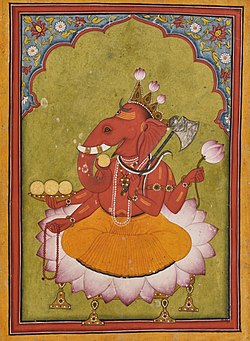
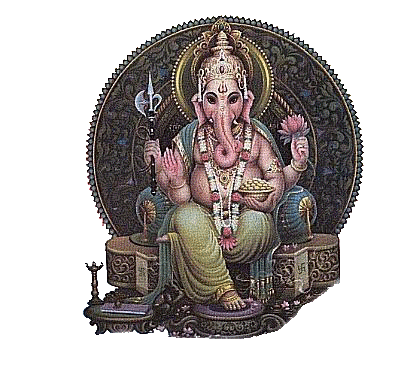
Festivals associated with Ganesh are Ganesh Chaturthi or Vināyaka chaturthī in the śuklapakṣa (the fourth day of the waxing moon) in the month of bhādrapada (August/September) and the Gaṇeśa jayanti (Gaṇeśa's birthday) celebrated on the cathurthī of the śuklapakṣa (fourth day of the waxing moon) in the month of māgha (January/February)."
There are many other important Ganesha temples at the following locations: Wai in Maharashtra; Ujjain in Madhya Pradesh; Jodhpur, Nagaur and Raipur (Pali) in Rajasthan; Baidyanath in Bihar; Baroda, Dholaka, and Valsad in Gujarat and Dhundiraj Temple in Varanasi, Uttar Pradesh. Prominent Ganesha temples in southern India include the following: Kanipakam in Chittoor; the Jambukeśvara Temple at Tiruchirapalli; at Rameshvaram and Suchindram; Karpaka Vinayakar Temple in Tamil Nadu; at Malliyur, Kottarakara, Pazhavangadi, Kasargod in Kerala, Hampi, and Idagunji in Karnataka; and Bhadrachalam in Andhra Pradesh.
Ganesha is Vighneshvara or Vighnaraja, the Lord of Obstacles, both of a material and spiritual order. He is popularly worshipped as a remover of obstacles, though traditionally he also places obstacles in the path of those who need to be checked. Paul Courtright says that "his task in the divine scheme of things, his dharma, is to place and remove obstacles. It is his particular territory, the reason for his creation."
Krishan notes that some of Ganesha's names reflect shadings of multiple roles that have evolved over time. Dhavalikar ascribes the quick ascension of Ganesha in the Hindu pantheon, and the emergence of the Ganapatyas, to this shift in emphasis from vighnakartā (obstacle-creator) to vighnahartā (obstacle-averter). However, both functions continue to be vital to his character, as Robert Brown explains, "even after the Purāṇic Gaṇeśa is well-defined, in art Gaṇeśa remained predominantly important for his dual role as creator and remover of obstacles, thus having both a negative and a positive aspect".
The canonical literature of Jainism does not mention the worship of Ganesha. However, Ganesha is worshipped by most Jains, for whom he appears to have taken over certain functions of Kubera. Jain connections with the trading community support the idea that Jainism took up Ganesha worship as a result of commercial connections. The earliest known Jain Ganesha statue dates to about the 9th century. A 15th century Jain text lists procedures for the installation of Ganapati images. Images of Ganesha appear in the Jain temples of Rajasthan and Gujarat.
Friday, October 28, 2011
Free Cat Screensaver Download
In 1997, Berkeley Systems was acquired by the Sierra On-Line division of CUC International. Joan Blades and Wes Boyd, the founders of Berkeley Systems, went on to create MoveOn.org.
As well as the included animated screensavers, it allowed the development and use of third-party modules, of which many hundreds were created by the height of After Dark's popularity.
A 3D version of the toasters featuring swarms of toasters with plane wings, rather than bird wings, is available for XScreenSaver.
Sierra released a Flying Toaster video game for cell phones in 2006.
The toasters were the subject of two lawsuits, the first in 1993, Berkeley Systems vs Delrina Corporation, over a module of Delrina's Opus 'N Bill screensaver in which Opus the penguin shoots down the toasters. Delrina later changed the wings of the toasters to propellers in order to avoid infringing the trademark. The second case was brought in 1994 by 1960s rock group Jefferson Airplane who claimed that the toasters were a copy of the winged toasters featured on the cover of their 1973 album Thirty Seconds Over Winterland. The case was dismissed because the cover art had not been registered as a trademark by the group prior to Berkeley Systems' release of the screensaver.
As well as the included animated screensavers, it allowed the development and use of third-party modules, of which many hundreds were created by the height of After Dark's popularity.
A 3D version of the toasters featuring swarms of toasters with plane wings, rather than bird wings, is available for XScreenSaver.
Sierra released a Flying Toaster video game for cell phones in 2006.
The toasters were the subject of two lawsuits, the first in 1993, Berkeley Systems vs Delrina Corporation, over a module of Delrina's Opus 'N Bill screensaver in which Opus the penguin shoots down the toasters. Delrina later changed the wings of the toasters to propellers in order to avoid infringing the trademark. The second case was brought in 1994 by 1960s rock group Jefferson Airplane who claimed that the toasters were a copy of the winged toasters featured on the cover of their 1973 album Thirty Seconds Over Winterland. The case was dismissed because the cover art had not been registered as a trademark by the group prior to Berkeley Systems' release of the screensaver.
Thursday, October 27, 2011
Animal adaptation
A conventional fixed-wing aircraft flight control system consists of flight control surfaces, the respective cockpit controls, connecting linkages, and the necessary operating mechanisms to control an aircraft's direction in flight. Aircraft engine controls are also considered as flight controls as they change speed.
If the thrust-to-weight ratio is greater than the local gravity strength (expressed in gs), then flight can occur without any forward motion or any aerodynamic lift being required.
If the thrust-to-weight ratio times the lift-to-drag ratio is greater than local gravity then takeoff using aerodynamic lift is possible.
All animals and devices capable of sustained flight need relatively high power to weight ratios to be able to generate enough lift and/or thrust to achieve take off.
To create thrust so as to be able to gain height, and to push through the air to overcome the drag associated with lift all takes energy. Different objects and creatures capable of flight vary in the efficiency of their muscles, motors and how well this translates into forward thrust.
If the thrust-to-weight ratio is greater than the local gravity strength (expressed in gs), then flight can occur without any forward motion or any aerodynamic lift being required.
If the thrust-to-weight ratio times the lift-to-drag ratio is greater than local gravity then takeoff using aerodynamic lift is possible.
All animals and devices capable of sustained flight need relatively high power to weight ratios to be able to generate enough lift and/or thrust to achieve take off.
To create thrust so as to be able to gain height, and to push through the air to overcome the drag associated with lift all takes energy. Different objects and creatures capable of flight vary in the efficiency of their muscles, motors and how well this translates into forward thrust.
Subscribe to:
Posts (Atom)